The Herzl Diaries are now accessible to everyone!
The innovative "Herzl-Online" website offers direct
access to Theodor Herzl's diaries in their original handwriting, preserved in
the Central Zionist Archives. For the first time, visitors can view the
complete faithful German transcription exactly as Herzl penned it, alongside
Hebrew and English translations, as well as rare documents and photographs from
the visionary leader's private archive and other collections of the Central
Zionist Archives. In honor of Hebrew Language Day: A few insights into Herzl and the
Hebrew language.
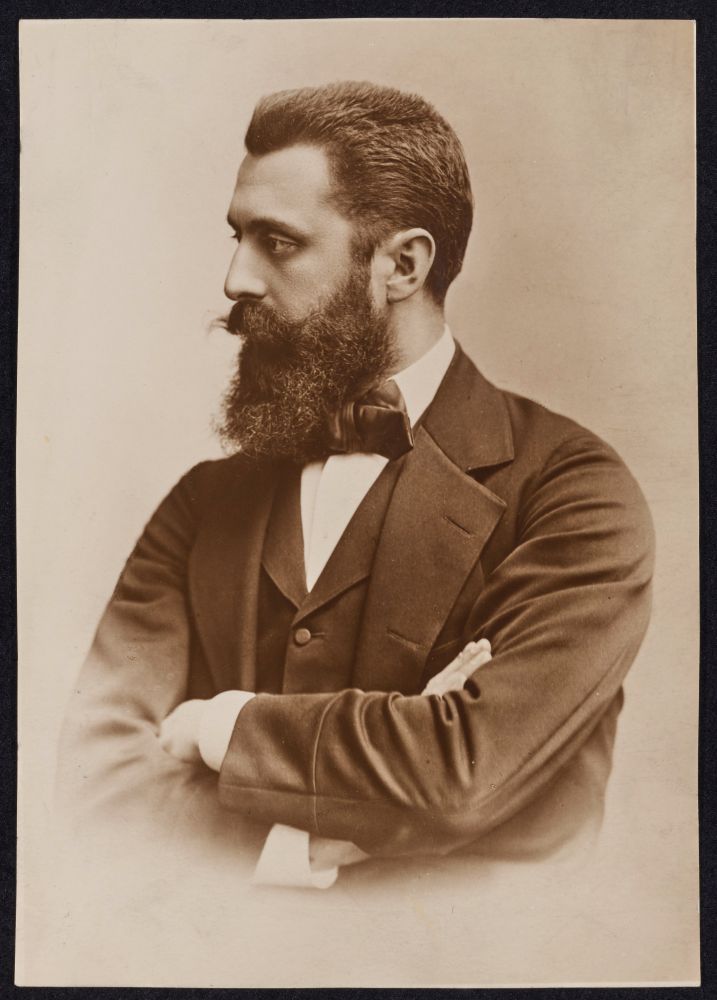
By: Suzanne Berns, Curator of the Theodor Herzl Archive
Ayelet Hillel Cohen-Orgad,
Education Department
Theodor Herzl's relationship with the Hebrew language was complex.
The revival of Hebrew was not part of his program for national revival. Beyond
his mother tongue of German - the language in which he typically wrote his
diaries - he was proficient in Hungarian and French. He also knew Latin,
English, a little Italian, and a few words of Yiddish. Despite his attempts to
learn Hebrew, he never mastered the language. Yet his diaries reveal that it
held an important place in his world, and he wove Hebrew expressions throughout
his writings and speeches.
A week after convening the First Zionist Congress in Basel, Herzl
traveled by train and reflected on an experience from the Sabbath before the
Congress - a moment that moved him "more than the opening speech and
closing speech and all the debates." It came when he recited a blessing in
Hebrew after being called up to the Torah during prayer at the Basel synagogue. Having arrived several days before the Congress opened, he accepted
an invitation from Rabbi Arthur Cohn. With help from a community member, he
memorized the blessing: "Baruch Atah Adonai Eloheinu Melech Ha'olam Asher
Bachar Banu Mikol Ha'amim V'natan Lanu Et Torato" (Blessed are You, Lord
our God, King of the universe, who has chosen us from all peoples and given us
His Torah). In his diary, he described how "the few Hebrew words of the
brokhe (Hebrew blessing) caused me more anxiety than my welcoming and closing
address..." He wrote the word "brokhe" with Ashkenazic/Yiddish
pronunciation [der hebräischen Broche] (September 6, 1897, Diary 5, page 69).
Benjamin Ze'ev, Herzl's Hebrew name written in Hebrew letters, is
documented from his childhood in Budapest, when his father Jacob registered him
as a member of the Chevra Kadisha (burial society). He did not often sign with
his Hebrew name. As a journalist for the Austrian newspaper Neue Freie Presse,
he signed as Theodor Herzl. Only when he initiated the publication of Die Welt,
the Zionist weekly newspaper printed in German, did he sign his articles with
his Hebrew name, Benjamin Ze'ev, in Latin letters - Benjamin Seff.
Occasionally, he also signed this way on letters he sent to those close to him.
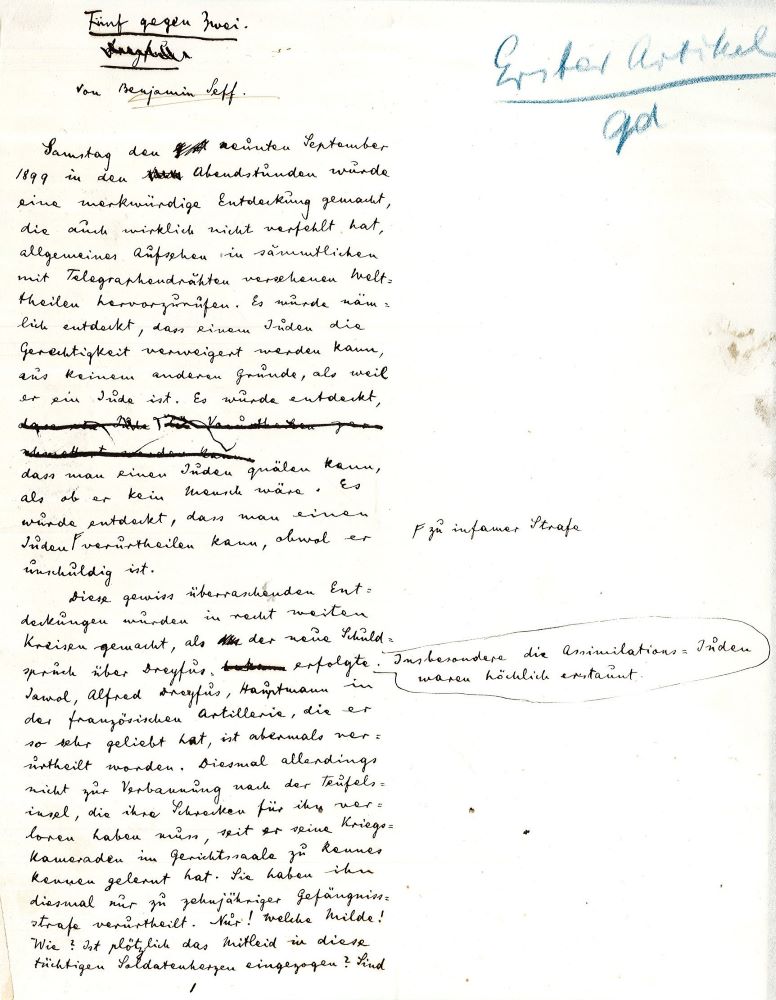
Herzl signs with his Hebrew name, Benjamin Seff (Benjamin Ze'ev).
Manuscript of an article for the newspaper Die Welt (published September 15,
1899) regarding the trial of Alfred Dreyfus (H1\719)
In his second will, dated May 1900, he requested that his name,
Benjamin Ze'ev, be inscribed in Hebrew letters on his tombstone alongside the
German text. The request was honored, and his Hebrew name appeared on the
tombstone at Vienna's Döbling Cemetery until his remains were transferred for
reburial in the Jewish State.
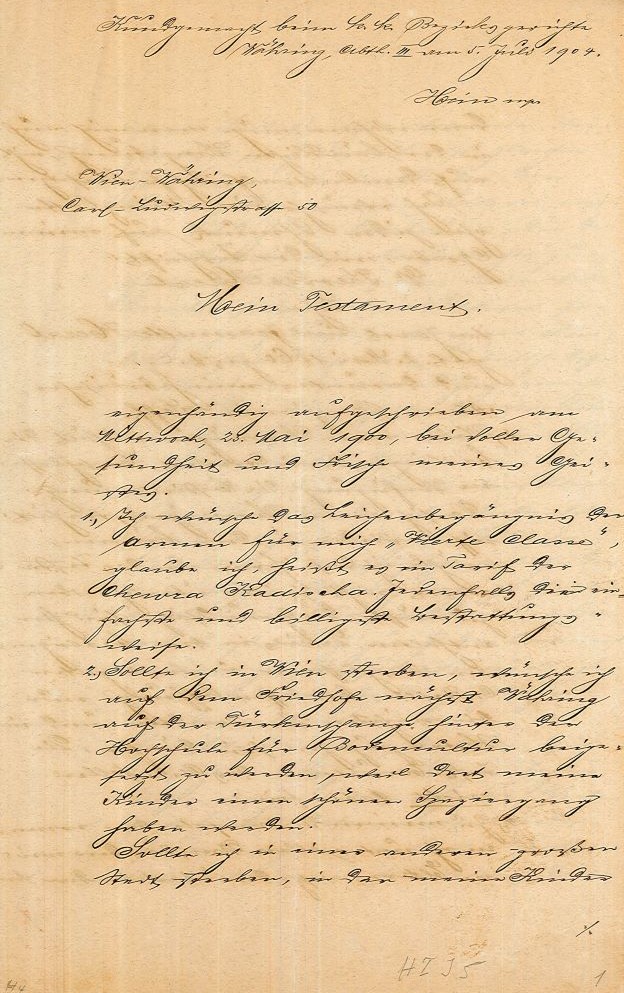
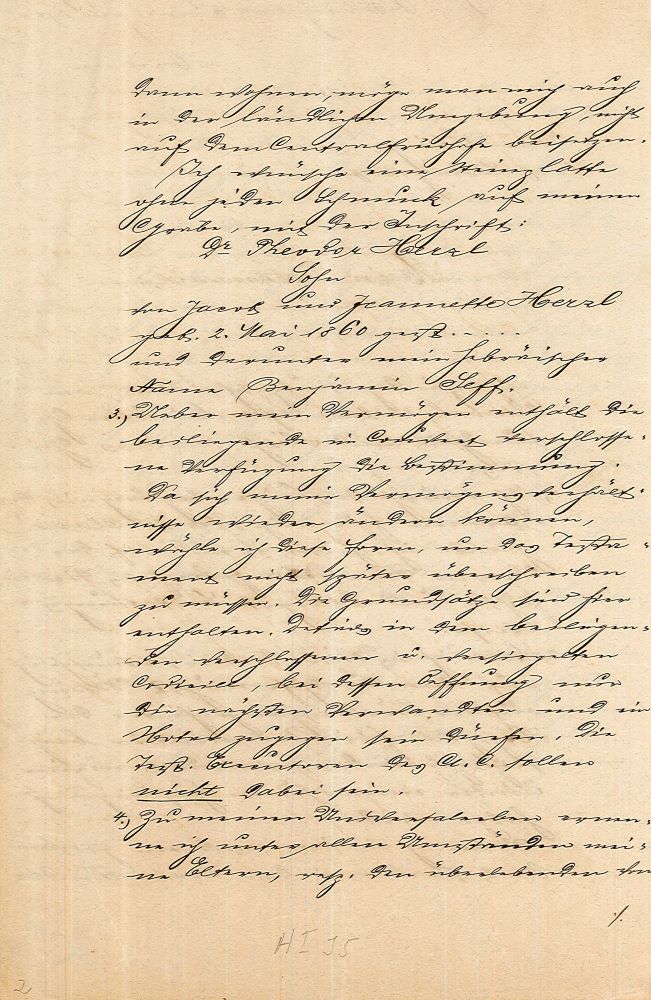
Theodor Herzl's second will, showing the instruction to write his
name Benjamin Ze'ev in Hebrew letters on the tombstone, May 23, 1900, official
transcript of the Imperial Court (H1\52)
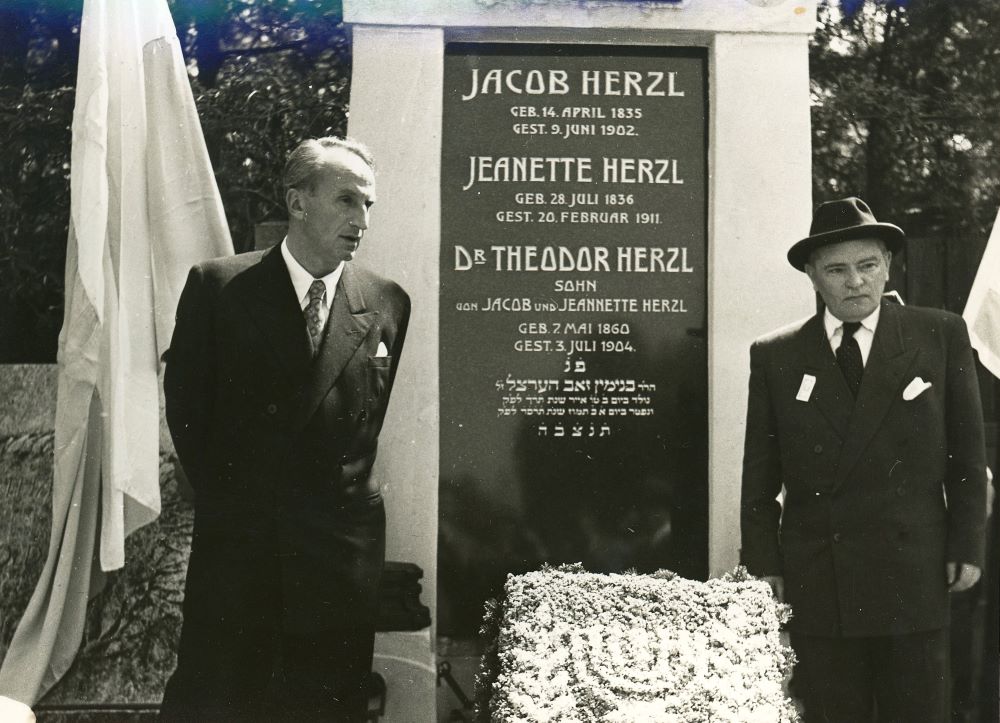
The tombstone of Theodor Herzl's grave at Döbling Cemetery in
Vienna, with the Hebrew inscription: "Here lies Dr. Benjamin Ze'ev Herzl
of blessed memory," August 1949 (PHG\1310602)
The new Herzl-Online website allows users to easily locate
instances where Herzl signed with his Hebrew name on letters and telegram
drafts preserved in his diaries.
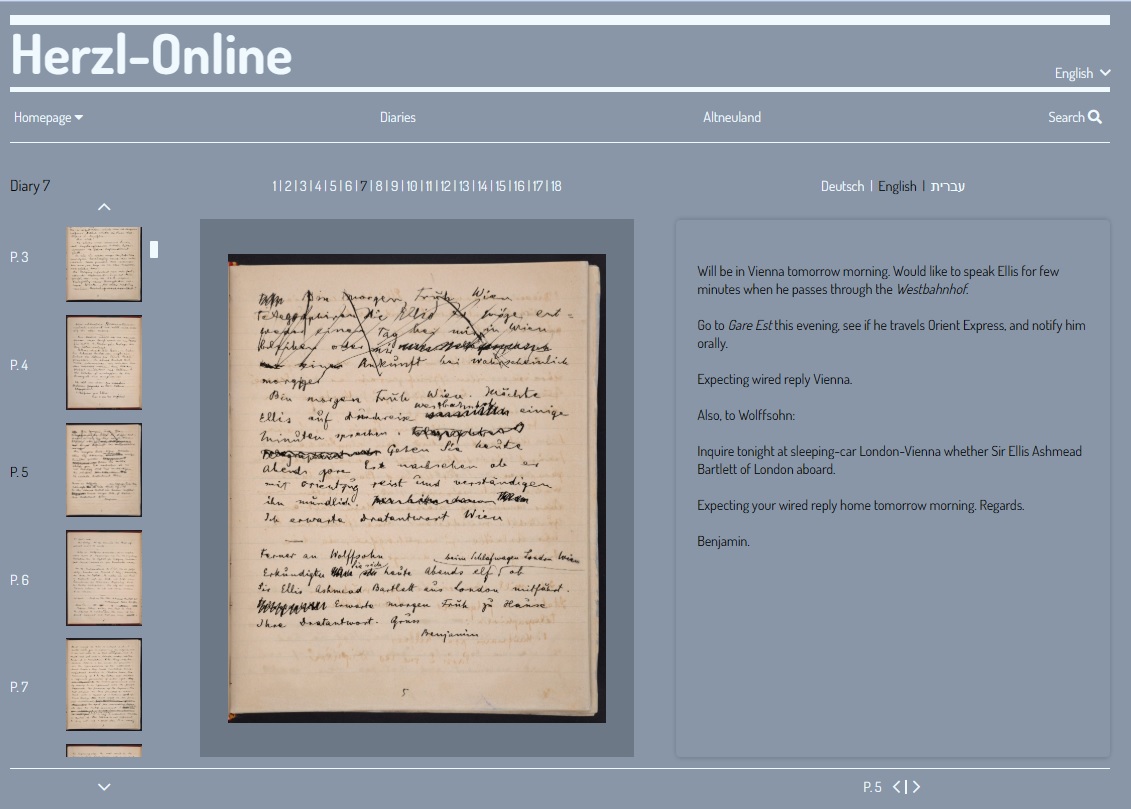
Herzl signs with his Hebrew name, Benjamin, in a telegram draft to
David Wolffsohn, April 5, 1899, Diary 7 page 5. Screenshot from the Herzl-Online website.
At home, Herzl and Julie spoke German with their children, but the
children also learned English, French, and Hebrew. The Theodor Herzl Archive
preserves a page where Pauline, his eldest daughter, practiced writing in
Hebrew letters. In childish, hesitant script without spaces, she writes her
name and her father's full name.
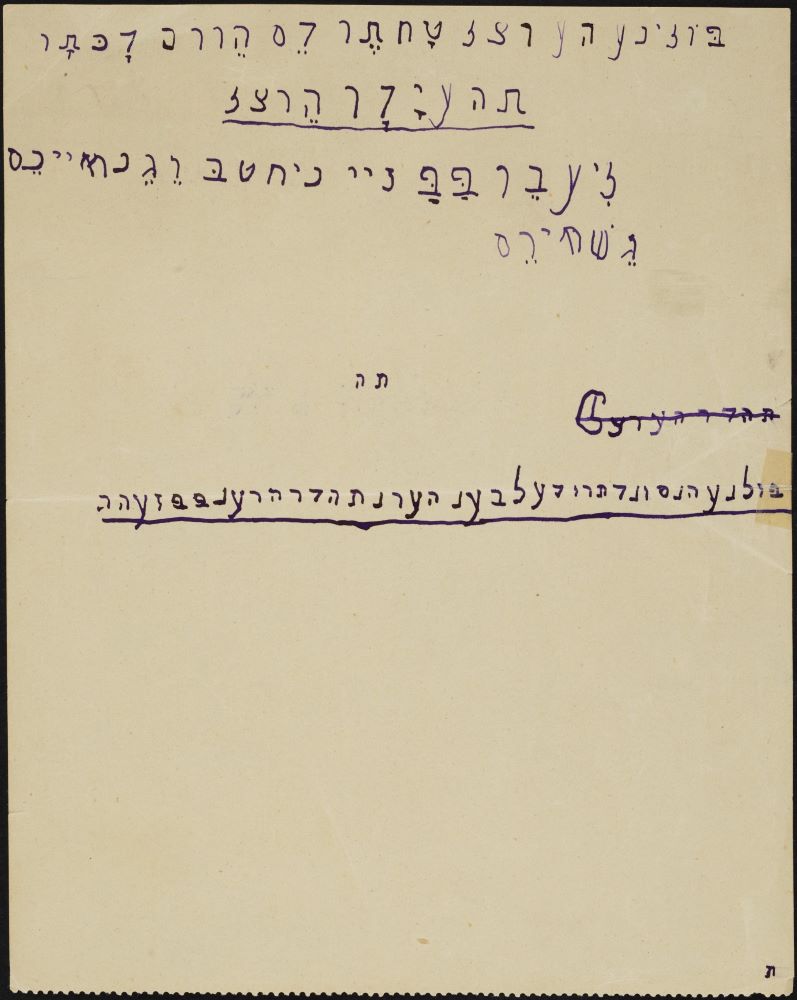
Writing exercise in Hebrew letters by Pauline Herzl. The top line
reads: Pauline Herzl, daughter of Mr. Dr. Theodor Herzl (H1\1365-2) Page 148 – Diary 8 – Herzl-Online
Herzl was enthusiastic about his children's progress in learning
Hebrew. Josef Patai, one of the first Herzl researchers, quotes Dr. Weinstein,
the children's Hebrew teacher, who recalled that each day Pauline, Hans, and
Trude would come to Herzl's study to play with him for half an hour. When their
time was up, he would pull out his pocket watch, and the children knew their
father needed to return to his work. One day, little Hans refused to leave and
said in Hebrew, "I won't go" (Lo elech). Herzl was moved, hugged him,
and allowed him to stay another half hour.
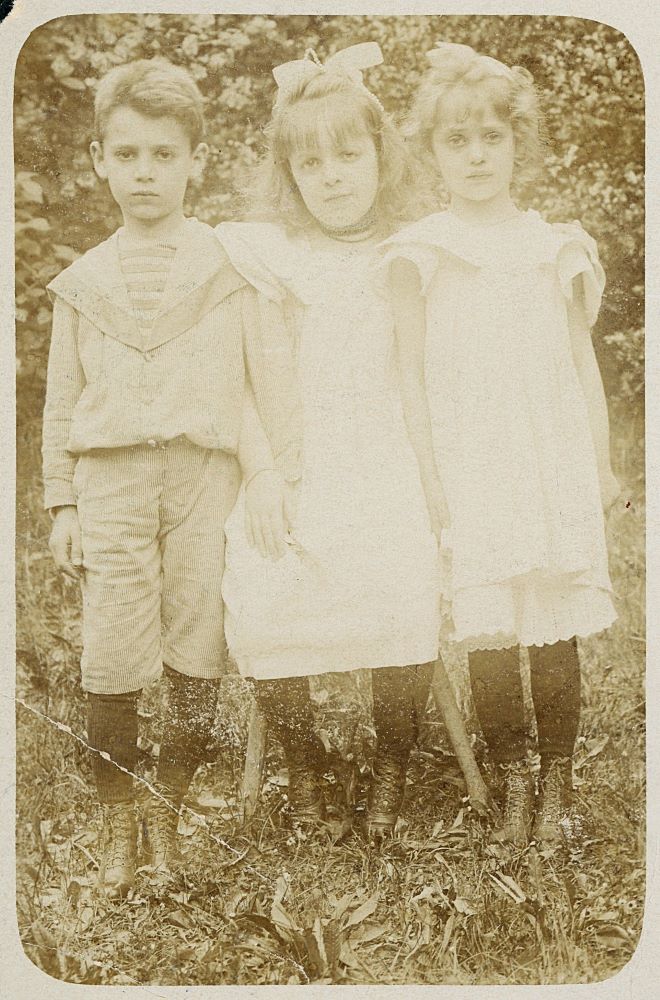
Photograph of Trude, Pauline, and Hans Herzl, taken from a postcard
sent in 1899 (PHG\1002446)
In his diary, Herzl described how Hebrew became part of his young
children's daily life. When they were aged 8 to 11, he wrote about their
bedtime routine: "They made their daily jokes, draped bedclothes around
themselves after they had been undressed, lustily sang their way into the
bathroom, danced into their beds, and said their evening prayers; today I made
them say a Hebrew prayer in addition to
the German one."
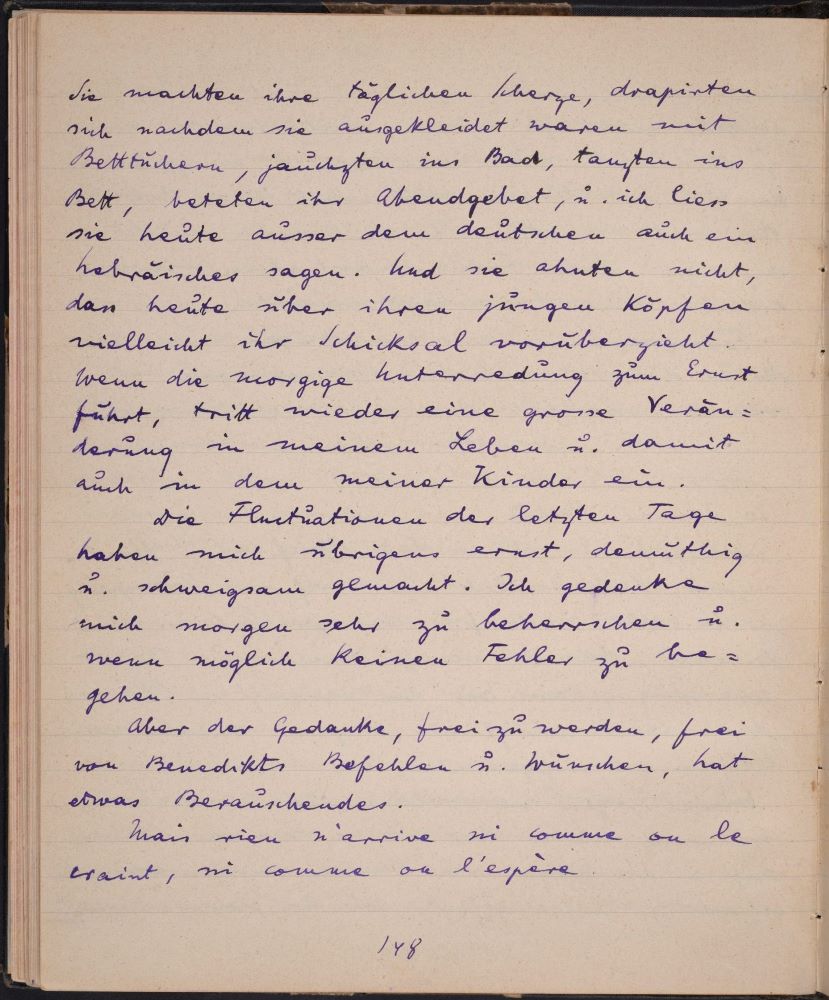
Today I had them say a prayer in Hebrew in addition to the German
one," January 10, 1901, Diary 8, page 148
Although Herzl did not master Hebrew, he chose to end the closing
speech of the Sixth Zionist Congress, delivered in the midst of the storm over
the "Uganda Plan", with Hebrew words from the sources: Im Eshkachech
Yerushalayim, Tishkach Yemini (If I forget thee, O Jerusalem, let my right hand
wither). In his diaries, he also inserted Hebrew words and expressions, such as
Leshanah Haba'ah Bjerushalayim (Next year in Jerusalem), a cry the enthusiastic
crowds shouted to him as they waited at the train station in Sofia, which he
recorded again with Ashkenazic pronunciation as leschonoh haboh beruscholajim.
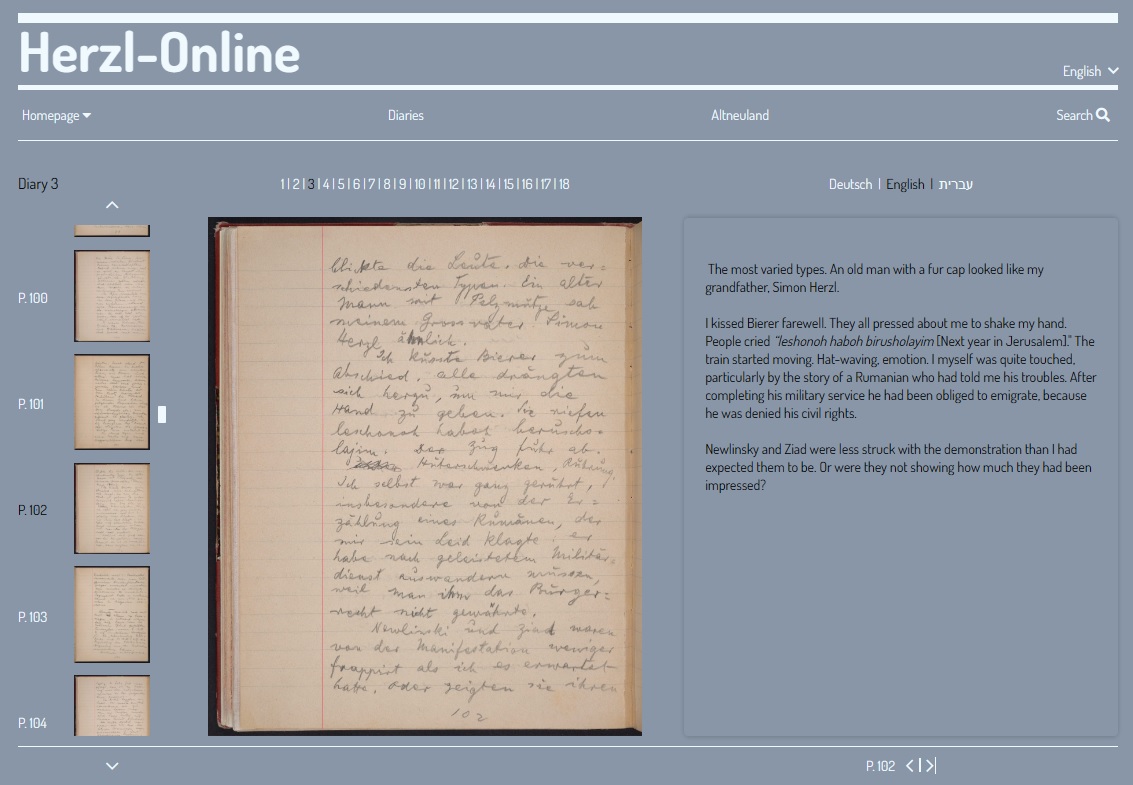
Leschonoh haboh beruscholajim - Page from Herzl's
diary in his handwriting with the Hebrew translation alongside, June 1896
(Diary 3 page 102).
Screenshot from the Herzl-online website
For the first time, the Herzl-Online website allows anyone
interested to read Herzl's words in his handwriting, as he wrote them—spelling
mistakes, grammatical errors, and even crossed-out words (when legible) are all
preserved. This authentic German transcription appears alongside Hebrew and
English translations, making it easy to read and compare the original with the
translations. In addition to the diaries, the website displays the handwritten
manuscript of Herzl's novel Altneuland, in which he laid out his vision for the
future Jewish state in the Land of Israel. The book was published in German in
1902 and, within a short time, was translated and printed in many languages,
including Hebrew.
The new website can lead to a deeper and more meaningful
acquaintance with Herzl's thoughts and plans, and thus to new discoveries. You
are invited to enter and discover for yourselves!
~ Published on 1 January 2026 ~