The industrial revolution of the 19th century and the Enlightenment created a demand for a new kind of journalism, one that would serve the needs of "the age of the masses". This era saw the birth of modern journalism which dealt with political and social issues pertaining to all society. At this time the field of journalism took on the role of the watchdog of the democratic process, itself a new phenomenon. In England, The Times reached unprecedented circulation, and acquired new competitors such as The Daily Telegraph and The Guardian. In the United States, The New York Times became the most widely read newspaper in the world, and The New York Herald pioneered the genre of investigative journalism. The Crimean War of the mid 1850's and the American Civil War, that broke out five years later, were the wars most covered by journalists until that point. The reports from the battlefields horrified civilians, who had previously been comfortably unfamiliar with the face of war. These reports emphasized the emergence of a new element in the political arena: public opinion.
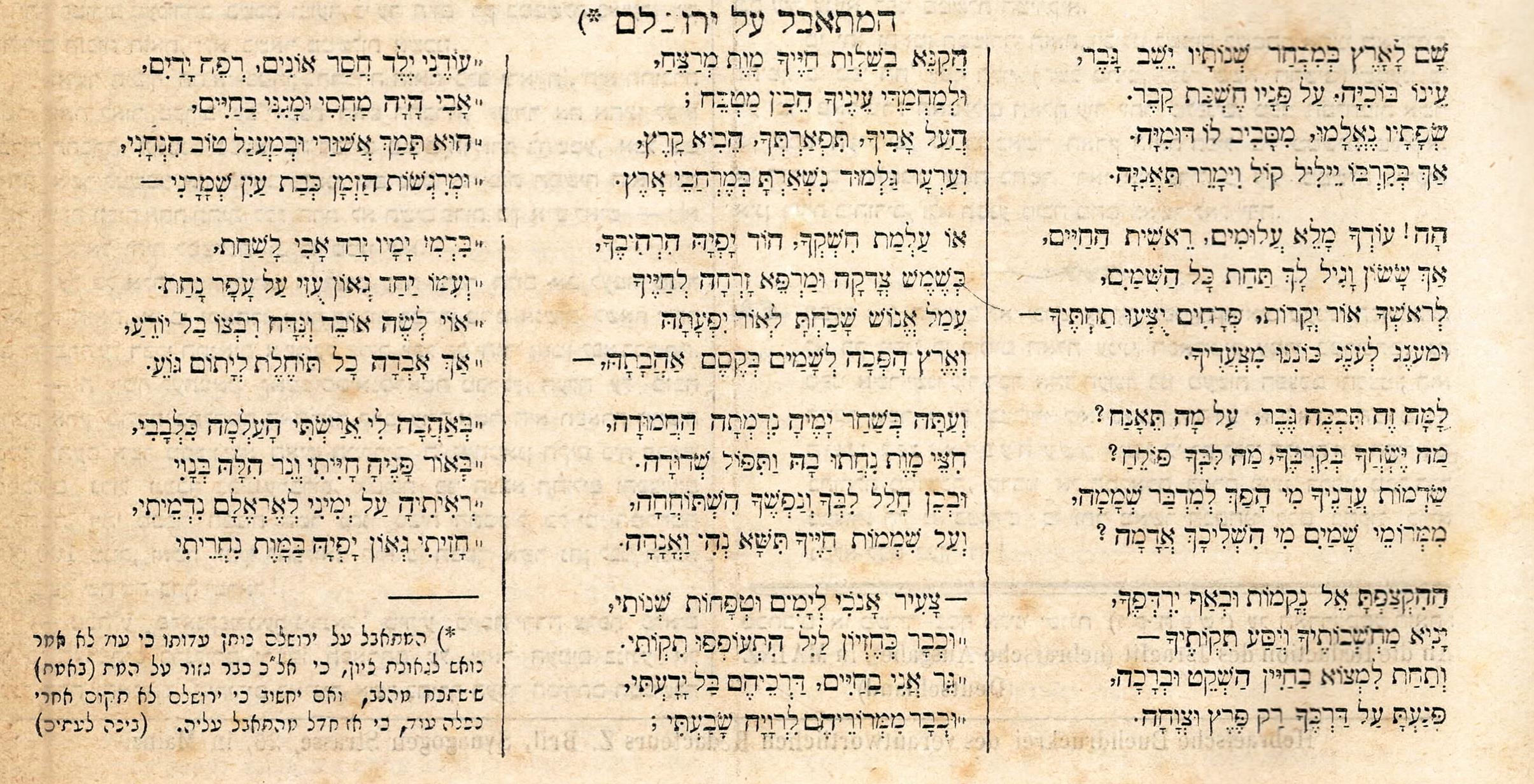
Jewish journalism of the era was also transformed by these phenomena. Jewish newspapers had begun to appear in Europe already in the 17th century, but only in the 19th century, as a result of the European national awakening and the emergence of popular journalism, did Hebrew newspapers appear in Europe, a few decades before the Hebrew revolution that Eliezer Ben- Yehuda introduced. The Magid newspaper began to appear in 1856, followed four years later by the Melitz. Three years after that, in 1863, the winds of change reached Palestine, with the appearance of Ha- Levanon, the first local paper in Hebrew.
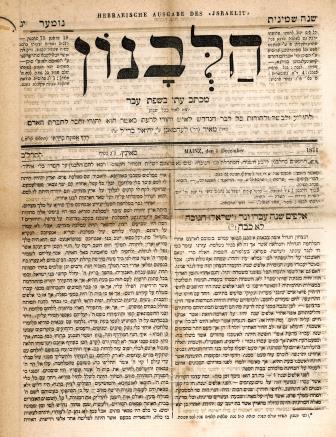
Ha- Levanon was founded by Yoel Moshe Salomon, Michal Hacohen and Yechiel Brill, who was its chief editor. As a Hebrew newspaper in a world where Hebrew was scarcely spoken outside of the synagogue, its main target audience was the members of the Yishuv, the Jewish settlement in Palestine. During the years in which the paper was active, before the founding of the Zionist movement, and even before the Hibat Zion movement, a bitter debate divided the Yishuv and European Jewry. The debate was between those who believed the Yishuv should promote the development of agricultural settlements, and those who thought the current situation, where the activities of the Yishuv were based on the learning of the Torah and maintained by donations from the Jewish world, should remain unchanged. The debate was, above all, a cultural one. The call to found agricultural settlement in Palestine was perceived by Orthodox Jews as an attempt by "modern", more secular elements in the Jewish world to introduce modern values and ways of life into the most symbolic bastion of Jewish tradition. Ha- Levanon expressed the stance of the Ashkenazi Orthodox Perushim, those who wished to guard the traditional way of life, based on the study of the Torah in the Holy Land. This stance received a wide platform within the pages of the newspaper. Another aspect that expressed the traditional stance of the newspaper was its Halacha section, dedicated to polemics regarding innovations in Jewish law and tradition.
In the beginning of the 1880's, alongside the formation of the Hibat Zion movement, the newspaper's stance toward agricultural settlements changed. Yehiel Brill, the editor of the paper, even began to be personally involved in bringing the Jews of the First Aliyah from Russia in 1882, as well as in the founding of Ekron (later Mazkeret Batia). This venture sent Brill into heavy debts, and the paper followed him. This was one of the main reasons Ha- Levanon did not appear regularly after 1882. In 1886, after Brill passed away, it ceased to be published.